23 October 2026 · 5 min read
Best Time for a Motorcycle Tour in Bosnia
Spring, summer or autumn? Why altitude sets the riding season in Bosnia and when our Balkan tours take place.
Read moreTrip planning
Twisting mountain passes, empty gravel tracks, canyons and the sea – all just one or two days' ride from Germany, Austria and Switzerland. The Balkans are one of Europe's most exciting motorcycle destinations, and many of the roads are still pleasantly quiet.
A little planning turns the idea into a great trip. Here you'll find the essentials: which countries are worth it, when to ride, and what's different at the borders and when paying.
“The Balkans” is a big place. For a motorcycle trip from Central Europe, the countries of the former Yugoslavia are the obvious choice: they border one another directly and link up easily into a round trip.
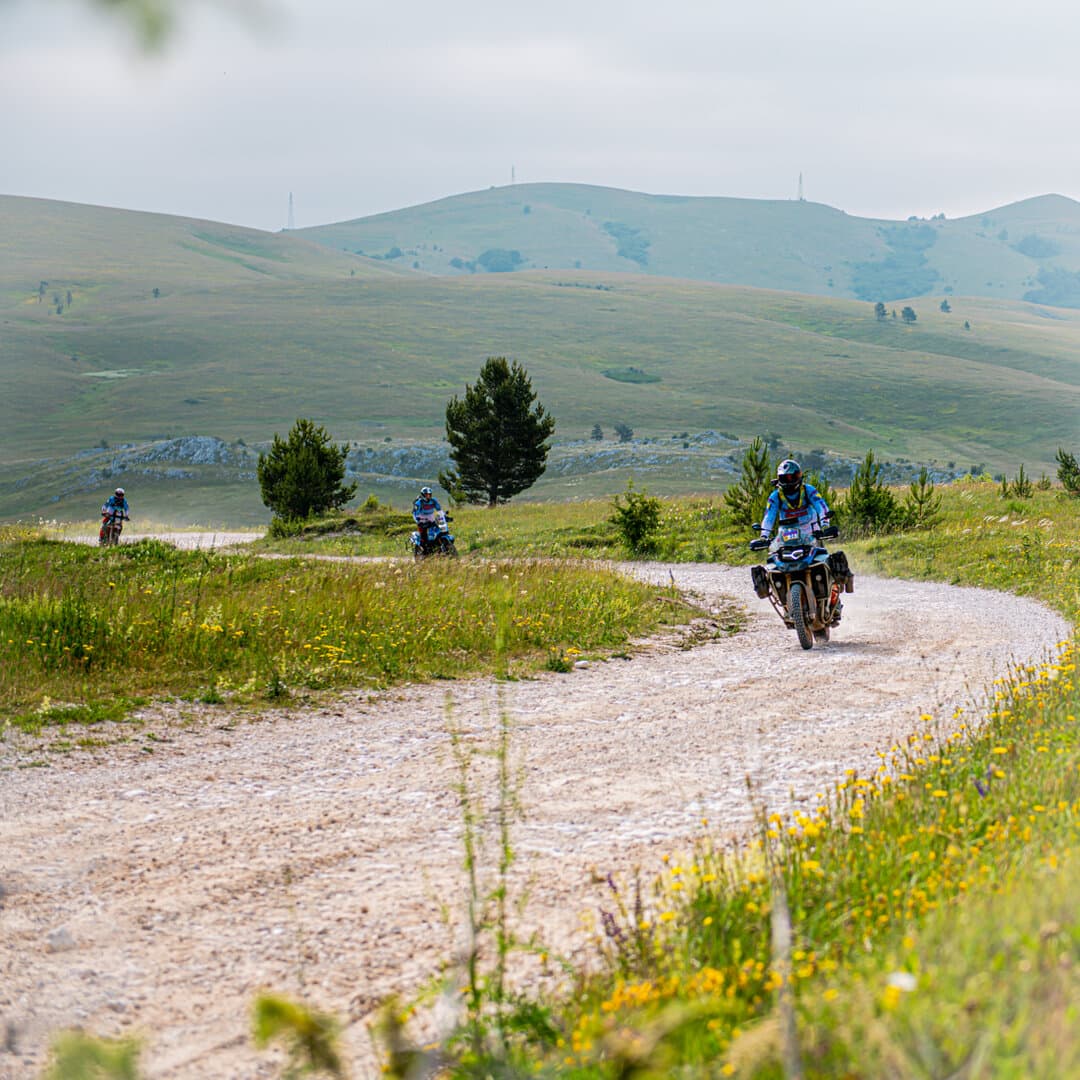
The Balkans have something for both kinds of rider. If you love corners, Slovenia, the Croatian coast and Montenegro offer some of the finest roads in Europe. If you're after gravel, you'll be happiest in Bosnia and western Serbia – here, unsurfaced tracks between villages are perfectly ordinary roads.
For tarmac fans, we run the Balkan Grand Tour: around 3,500 km through five countries. For off-road riders, the highlight is the Bosnia Marathon, with around 70% gravel.
Slovenia and Croatia are part of the EU and the Schengen Area. Bosnia and Herzegovina, Montenegro and Serbia are not – there are checks at these borders, and at weekends and during the holiday season you may have to wait. Smaller border crossings are often quicker.
German, Austrian and Swiss citizens can enter all five countries with a valid national ID card or passport. Before every trip, check the latest entry requirements with the German Federal Foreign Office, the Austrian Foreign Ministry or the Swiss FDFA – or your own country's foreign ministry.
In Slovenia, Croatia and Montenegro you pay in euros. Bosnia and Herzegovina uses the convertible mark (€1 = 1.95583 KM) and Serbia the dinar. Cards are accepted almost everywhere in towns, but carry cash in mountain villages.
Bosnia, Montenegro and Serbia are not part of the EU roaming zone. Check your mobile plan's terms before you go, or get an eSIM for the region.
The Balkans are easy to explore independently. A guided motorcycle tour is still worth it if you're short on time, want to ride the best roads without lengthy research, or want to go off-road. In Bosnia especially, verified GPS tracks matter, because landmines may still lie away from known routes – more on this in our article Off-road in Bosnia.
On a guided tour, the route, hotels and emergency team are all taken care of, and you ride in a group of like-minded people. You'll find all current dates and prices in the overview of our Balkan motorcycle tours.
May to June and September to early October. In high summer it's often very hot on the coast, while the mountains stay more pleasant.
Not if you're a German, Austrian or Swiss citizen: you can enter Slovenia, Croatia, Bosnia and Herzegovina, Montenegro and Serbia with a valid national ID card. Check the latest requirements before you travel.
Euros in Slovenia, Croatia and Montenegro, the convertible mark (KM) in Bosnia and Herzegovina, and the dinar in Serbia.
Yes. Balkan Marathon offers guided off-road tours in Bosnia, tours in Croatia and Serbia, and the 11-day Balkan Grand Tour through five countries.
23 October 2026 · 5 min read
Spring, summer or autumn? Why altitude sets the riding season in Bosnia and when our Balkan tours take place.
Read more18 October 2026 · 9 min read
Around 1,000 km from Munich, 800 km from Vienna, 1,250 km from Zurich: which route works best, what papers you need at the border and what’s different once you arrive.
Read more23 October 2026 · 5 min read
Eleven riding days, around 3,500 km and five countries: what to expect on the Balkan Grand Tour, who it suits and what you need at the borders.
Read more