23 October 2026 · 5 min read
Bosnia Rally 2027 in Kupres: How a Riding Day Works
From check-in on 12 June to checkout on 19 June: what a week at Bosnia Marathon 2027 looks like, and how a single riding day actually works.
Read moreSafety
Gravel roads between mountain villages, old forestry tracks, karst plateaus and hardly any traffic: for enduro and adventure riders, Bosnia and Herzegovina is one of the most exciting destinations in Europe. While off-road riding is increasingly restricted in many EU countries, there are still hundreds of kilometres of unsurfaced tracks here that are in everyday use.
To keep it a good experience, there are two things you should know before your first gravel track: the rules off-road and the danger from landmines.
The war in the 1990s left traces that still haven’t been fully cleared. According to the figures Bosnia and Herzegovina reported in 2025 under the Ottawa Convention, around 823 km² were still considered suspected mine areas at the end of 2024 – about 1.6% of the country. Of this, around 165 km² are recorded as confirmed hazardous areas.
The areas shrink every year, but they’re still there. They lie mainly along the former front lines – often in woodland, on abandoned fields, on slopes and around destroyed buildings. Roads and regularly used tracks have been cleared.
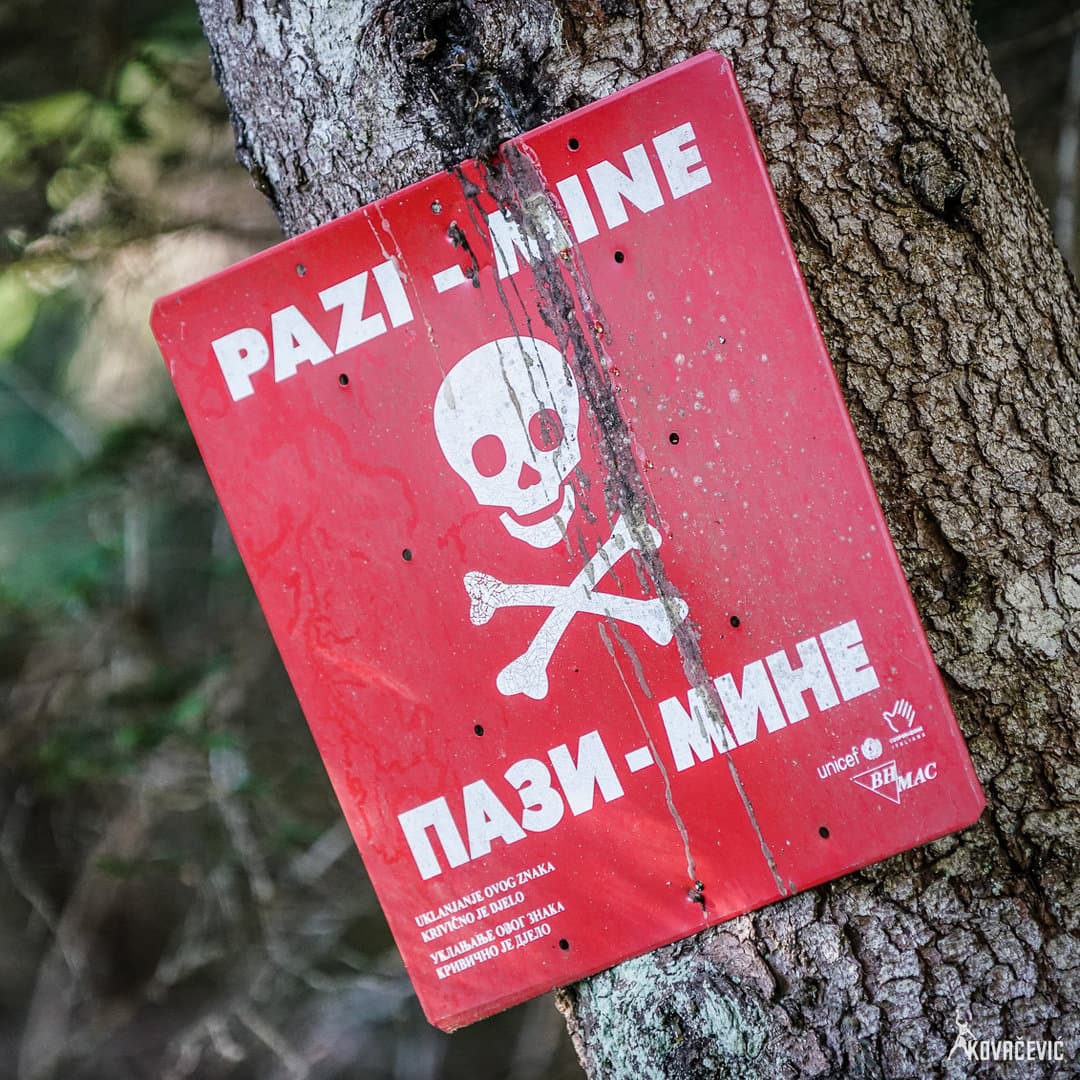
Marked hazardous areas are identified by red warning signs with a skull and the words “Pazi mine!” (Beware, mines!) or simply “Mine”. Sometimes there are only red markings, tape or posts. But be careful: not every suspected area is marked, and old signs may have fallen over or become overgrown.
The Bosnia and Herzegovina Mine Action Centre (BHMAC) publishes maps of known suspected areas. If you’re planning your own routes, it’s worth checking them before you set off.
The legal situation is less uniform than in central Europe. Bosnia and Herzegovina is made up of two entities – the Federation and Republika Srpska – plus the Brčko District, and matters such as forestry and nature conservation are regulated separately in each. A few basic rules apply everywhere, though:
Many gravel tracks lead through villages, across mountain pastures and past flocks of sheep. Ride slowly through villages, keep your distance from animals, close pasture gates behind you and say hello to people along the way. A legal, quiet exhaust isn’t just a requirement – it also helps make sure motorcyclists stay welcome here.
The safest way to experience Bosnia off-road is on routes that have been ridden and checked beforehand – by people who know the area and its history. That’s exactly how the Bosnia Marathon is set up: for every riding day there are GPX tracks for a Rally route and a Classic route, all participants are tracked via OWAKA GPS, and an emergency team is out on the course. You concentrate on riding, not on route-finding.
Yes, on public gravel roads and connecting tracks, where the normal road rules apply. Closed forestry roads, protected areas, meadows, hiking trails and private land are off-limits.
There is no danger on roads and regularly used tracks. It only becomes dangerous if you leave known tracks, ride cross-country or move around abandoned buildings and overgrown areas.
By red warning signs with a skull and the words “Pazi mine!”, or by red markings and tape. Not every suspected area is marked, so the rule is: always stay on known tracks.
23 October 2026 · 5 min read
From check-in on 12 June to checkout on 19 June: what a week at Bosnia Marathon 2027 looks like, and how a single riding day actually works.
Read more23 October 2026 · 6 min read
The T7 is a superb match for Bosnia's gravel and forest roads. Here is how to set it up, how to ride it on loose ground and which route suits you at the Bosnia Marathon 2027.
Read more23 October 2026 · 6 min read
Taking a big GS onto Bosnia's gravel works well if your expectations are realistic, you pick the Classic route and you adapt your technique to the weight.
Read more