23 October 2026 · 6 min read
Off-road group riding: how to ride safely
Dust, longer braking distances and mixed abilities: the rules that get an off-road group to the end of the day relaxed and in one piece.
Read moreRiding skills
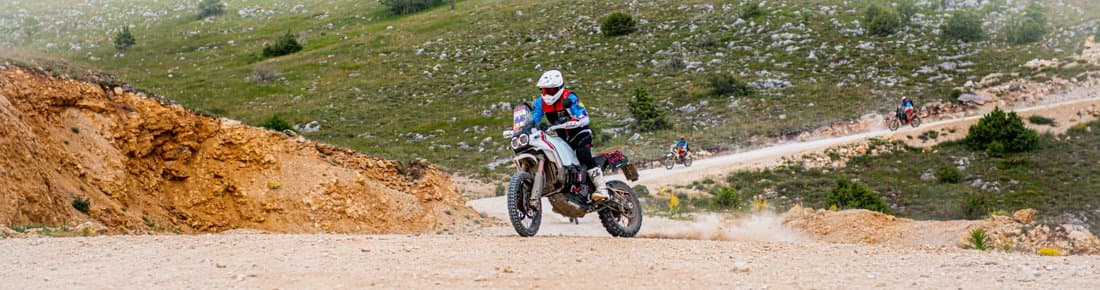
Plenty of riders buy an adventure bike because one day they want to ride where the tarmac ends. On the road the bike feels familiar. On the first loose gravel it does not: the front pushes, the rear goes light, and instinct makes you do exactly the wrong thing: stay seated, tense up, grab the front brake.
Good off-road training changes that faster than any trip on your own. Here is what really matters in a course, what to look for when choosing one, and how to combine training with an off-road trip such as Bosnia Marathon 2027.
Twenty years on the road give you good reflexes, but on loose ground some of them work against you. On tarmac you brake mostly with the front, sit firmly and steer through the bars. On gravel the front tyre has less grip than you expect, and the bike needs to move underneath you.
Off-road training replaces those road reflexes with new routines. That happens fastest on a closed training ground, where dropping the bike costs nothing but a bit of pride.
Whether it is a one-day course or a multi-day training, these basics belong on the programme:
Training on your own bike gives you the most, because you learn the exact weight, seat height and electronics you will travel with. On a big adventure bike such as a BMW R 1250/1300 GS or a Honda Africa Twin, lifting and slow-speed handling are half the battle.
Tyres matter too: on road-biased tyres you mostly learn how little grip they have on gravel. Knobblies pay off for both training and the trip; our guide to off-road motorcycle tyres explains which tyre suits which use. Fit crash bars, radiator and lever guards before the course, not after it.
Training six months before a tour is better than none, but the skills fade if you only ride tarmac afterwards. Ideally do two things: a basic course in spring and a refresher right before the trip, so the routines are fresh when it counts.
When choosing a course, look for small groups, instructors who travel themselves, and a clear welcome for big adventure bikes, not just light competition enduros.
For Bosnia Marathon 2027 we put the training directly before the tour: an experienced motorcycle instructor, working since the mid-1990s and with more than 16,000 riders trained, works with the group in Kupres on the two days before the event. He then accompanies the riders throughout all six riding days, so what you practised in the morning you use a few days later on real highland gravel.
Training is limited to 20 participants. The first 5 places are free; after that it costs €450 per person, added as a separate item when booking. On top of that you choose every day between the technical Rally route and the easier Classic route, which is meant for newcomers and big adventure bikes. Our guide how a Bosnia Marathon riding day works describes the week.
Still unsure whether an off-road trip is for you yet? Read our guide Bosnia enduro trip for beginners.
The basics are standing up, vision, clutch and throttle at walking pace, braking on loose ground, standing turns, climbs and descents, and lifting the bike.
Yes, especially then. At 230 kg and more, slow-speed balance, braking on gravel and lifting the bike are the skills that make a trip relaxed or exhausting.
Yes. An experienced instructor trains the group in Kupres on the two days before the event and then accompanies the riders throughout all six riding days. Up to 20 participants; the first 5 places are free, then €450 per person.
23 October 2026 · 6 min read
Dust, longer braking distances and mixed abilities: the rules that get an off-road group to the end of the day relaxed and in one piece.
Read more21 November 2026 · 5 min read
A GPX track shows you the way, not whether it is open today. What to know about tracks before an off-road trip in Bosnia.
Read more21 November 2026 · 5 min read
The tour price is only part of it. What is included, what is not, and what to budget for the whole week.
Read more